I hope the title of this article was not enough to disturb your centre 😉. The following is a perspective from me (Andy Wee) a Taiji practitioner and instructor in the School of Central Equilibrium. If after reading this article you have some thoughts or ideas to share, please email taijisoce@gmail.com.
Throughout the course of my Taiji journey I have heard people take the view of Taiji and subsequently the relaxed force as “just science”. For some people they say it’s basic physics. Now currently the biggest thing that people use to describe how the relaxed force is created in Taiji is the word “Fascia”.
Firstly, we have to ask ourselves, why is there such a strong appeal for Taiji to be scientific? In our modern world science is the substitute for the word “God” or “gods” to create or improve validity in our statement or ideas. When we disagree with an approach by someone, we say “that’s unscientific”. In the same way that perhaps someone in the past would say: “that is against Gods will”. On the opposite end, something that is labelled scientific is supposed to be true, something we can trust. But what this has led to is everyone saying that they are right because their way or idea is more “scientific”. In fact, it is often the case that when there are two opposing sides to a situation both will appeal to the fact that they are the more scientific one!
So, what am I saying when I say “Taiji is not scientific”? I am not saying that it never can be or will be. What I am saying is that our current scientific way of describing and understanding the world is not yet able to fully describe Taiji in a scientific way. Therefore, a lot of the concepts as it pertains to (like Qi and the relaxed force) cannot be fully grasped from a scientific lens and if you choose to look at it through this way your ability to grow and improve in the art will be limited. It may be the case that it is like how microbes are all around us but we only started seeing them when we invented the microscope. To further illustrate this concept further I give you a story:
A tale of two worlds
You (being the genius that you are) have figured out time travel and you decide to go back to the Stone Age. Along with time travel you invent a machine that allows you to communicate with the local cave men who are around at the time. You decide during your time here to tell a Cave man about electricity and so, being a prepared traveller, you open up your bag of future things and you show them a light bulb. When you turn on the light bulb the cave mans eyes glow with wonder. Before you have a chance to explain anything to him about electricity he runs away. You don’t think much of it. I guess he just wasn’t ready for this technology yet. You decide to go and look for some Woolly Mammoth.
Little did you know, the reason why the caveman ran off was because he started thinking about how to make the thing you just showed him. In his worldview the closest thing to your light bulb was his campfire. But it was so huge and consumed so much wood. How did you manage to make that fire so small?
You decide to use your time travel machine to go 30 years into the prehistoric future. You meet the caveman again. This time he is already an old man. But he remembers you and he is excited to see you! He tells you that he spent his whole life trying to understand “the lightbulb” and finally got it! He shows you the thing he has created. It doesn’t look anything like a light bulb. On closer inspection it looks like some sort of hand made match stick. He lights it and you realise it IS a hand made matchstick. Impressive you think (especially for 10,000BC) but not exactly what you were trying to show him.
What happened? The Caveman used his understanding of the world to explain something that he had no comprehension of. Through it he made something similar to what you showed him (a matchstick like a light bulb is a tiny light). But because he didn’t understand what was actually happening, he misses out on everything else electricity could do.
So, are you spending your lifetime like the caveman using the views you have on the world to explain something the way you think it should be? Or are you truly opening your mind to possibilities that are outside your current ideas and understanding?
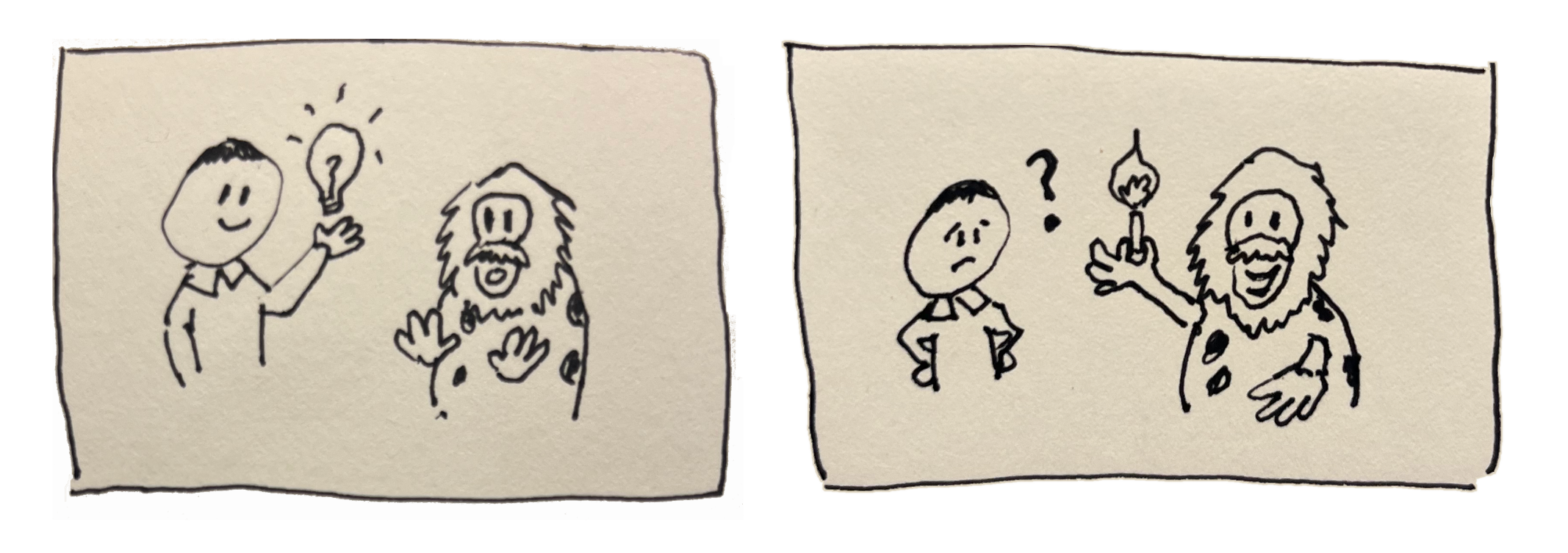
“Wow you managed to grasp exactly none of the concepts I was trying to show you!”
My perspective and approach:
Use the classics. Reference the classics. Use the descriptions and mechanics of the classics. It is that simple. If the classics say “let the Qi sink into the Dantian” just visualise that to be true. You don’t need to go searching for the Dantian or replacing Qi with something else that you are familiar with like blood circulation. Just visualise. You can put on your scientific hat after practice.
At the same time, I have to caution about being too esoteric as well. Sometimes people practice in ways that make it too mysterious and if your practice is ungrounded it won’t take you anywhere either. Remember that when the classics were written, things like Qi or meridian points like the Dantian were not mysterious things at all. They were just accepted as reality. You will never be able to reach the things you place on a pedestal, be it concepts or teachers.
If you need more, then study the old practitioners who you admire and listen to their commentaries on the classics. Don’t try and create your understanding and fit the art into that model. If you do that you will be like the caveman creating the matchstick instead of the lightbulb. Maybe you get something similar, but maybe you will leave a lot of possibilities and growth on the table. All the good teachers talk about reading the classics. All the good teachers talk about faith.
But of course, there is danger in faith. There are many people who put faith on the wrong things or people and then through it they end up on the wrong path with only wasted years to show for their practice. So how do you avoid that? I can understand the frustration that may entail. I don’t have all the answers but I have some suggestions that have been helpful for me and that may help in your journey:
Someone who is good in the art will constantly be referencing the classics. This is the north star. If they have not even heard of the classics… run away (or repulse monkey?).
They should allow you to feel their body and be able to express their principles in their movements and partner work.
Different people may have different interpretations of the classics. This is where your discernment will have to come into play. You may find one teacher has a deeper understanding of the art than another. Or one teacher teaches in a way that allows you to learn better from them. It doesn’t mean that necessarily the others are wrong.
When you find someone to learn from. Stick with them. There may be many ways up the mountain. Different people can take you on different paths. But if you try to take every path up you will never reach the top. Try a few and then pick one. After you pick one listen and follow what they say.
Read the classics yourself. Sit with the words in your heart. Let their meanings grow. Reflect on them. What did the author mean when they wrote this? Can the meaning be further refined? The beauty of the classics is that they are poetry. In poetry there is much more space for movement and growth in the meanings. If you read them well it is almost like the words are alive.
Practice. Taiji in the first instance is an experience. Nothing can beat the experience. I can describe to you the ocean, I can paint for you the waves. But nothing will be the same as standing by the shore feeling the water rush onto your body, with the sun on your face and the sand between your toes.

Never let your knowledge get in the way of a good experience!
When you start to feel it, you won’t need an explanation anymore. It will be real enough.
P.s. Thank you Mr Caveman for your efforts and being ablke to be an example for us.